
Rotobrush Air Duct Cleaning in University City: A Homeowner’s Guide
Rotobrush is effective cleaning equipment. It’s also a franchise marketing system, which means the quality of a Rotobrush cleaning in University City depends far more on the technician operating it than on the brand name on the machine. Most homeowners who search for it don’t know the difference between a full truck-mounted setup and a franchise van with a simplified tool. This guide explains how the system actually works, where it fits, and what to ask before you book.
What Is Rotobrush, and How Does It Actually Clean Your Ducts?
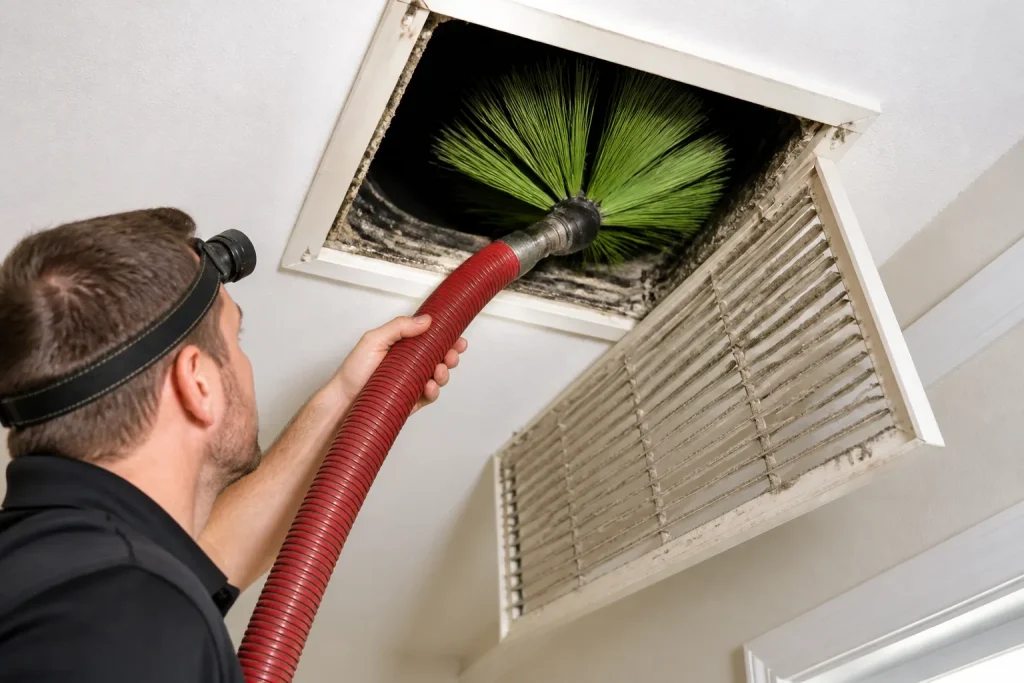
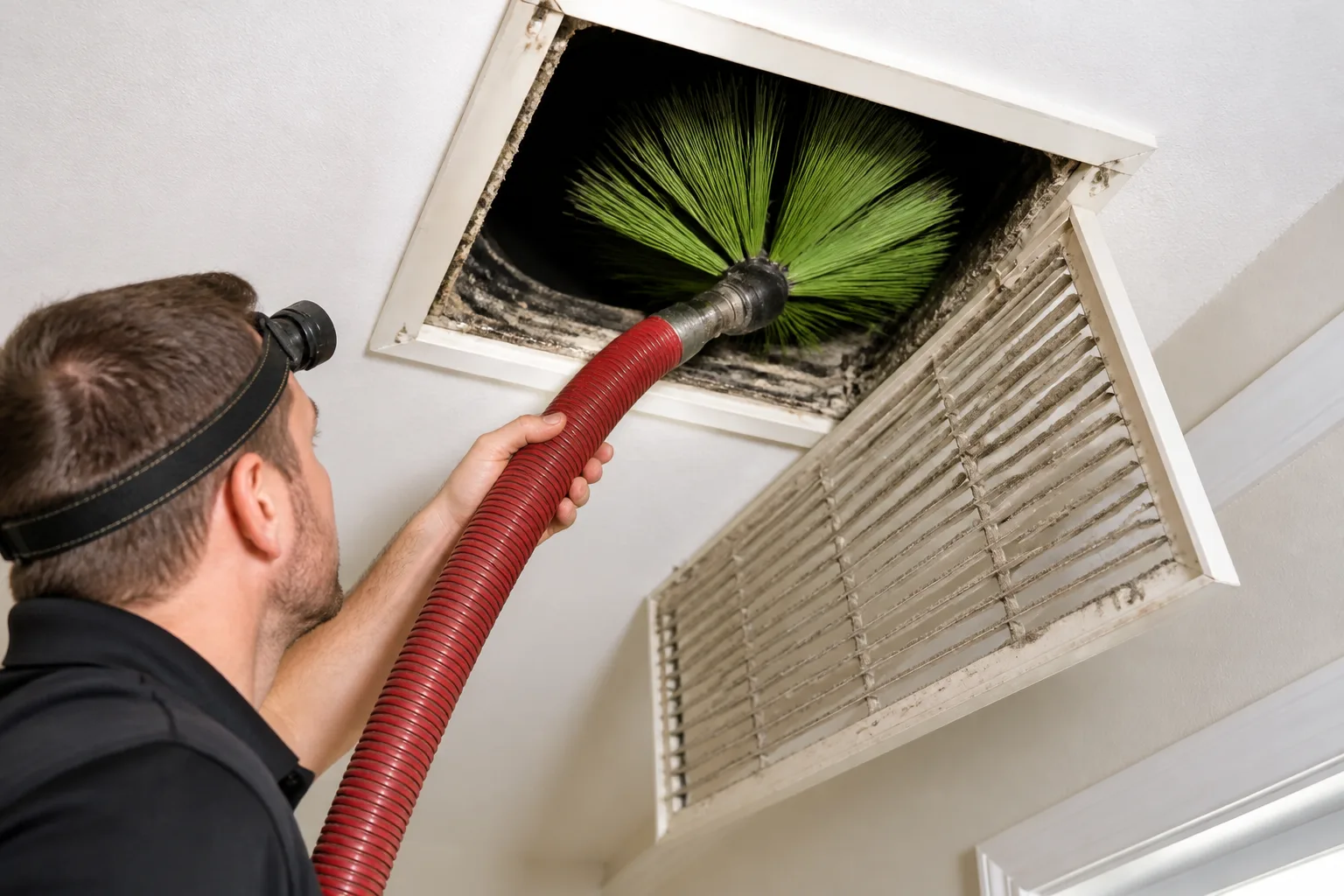
Rotobrush is a contact-cleaning method. A rotating brush head on a flexible whip is fed through the duct run, and the brush physically scrubs the interior surface while a vacuum captures what it loosens. That’s the core mechanism, and it’s a real one. Contact cleaning removes the layer of dust, lint and buildup that clings to the duct wall, which a vacuum alone can pass over without lifting.
Here’s where it gets useful to understand. There are three broad approaches in the trade:
- Contact cleaning (Rotobrush-style): a brush or whip physically agitates the duct surface while a vacuum pulls material out. Best at removing adhered buildup.
- Air-sweep: compressed air pushes debris toward a collection point. Fast, effective on loose material, less so on anything stuck to the wall.
- Negative-pressure-only: the system is put under vacuum to pull out what’s loose. Good as a final stage, weak as the only stage.
In our experience, the strongest cleanings combine contact agitation with negative pressure and a proper air filtration setup. Rotobrush is a solid tool inside that pipeline. It’s not a replacement for the whole pipeline. A duct system in University City with supply and return runs, branches and a plenum doesn’t get fully addressed by any single method on its own.
Which Ducts and Contamination Types Does Rotobrush Handle Best?
Rotobrush performs best on rigid sheet metal ductwork and on flexible duct where the technician can run the whip without damaging the liner. It’s also strong on adhered lint, settled dust and the kind of film that builds up in homes near ongoing construction or after a renovation. If you’ve had drywall work done, contact cleaning is usually the right first move, because drywall dust settles and sticks.
Where it’s not always the ideal first choice:
- Heavily contaminated systems: when there’s significant debris load or suspected microbial growth, a full negative-pressure setup with proper filtration (the kind of equipment Abatement Technologies is known for) needs to run alongside or before contact work, not after.
- Fragile flex duct: over-aggressive brushing can tear the inner liner. The technician’s judgment matters here, not the brand.
- Damaged or disconnected runs: cleaning a duct that’s leaking or unsealed at the joint doesn’t solve the problem. Sealing comes first. That’s why we treat duct repair and sealing as its own service line, not an upsell.
University City has a mix of older housing stock and newer builds, and the duct condition varies block to block. A system in a 1970s home and one in a recent build need different plans. Ask any provider what method they’re using for your specific duct material, and expect a real answer.
Why Rotobrush Is a Franchise Model, and What That Means for You
Rotobrush sells franchises, not a single standard of service. Each operator is an independent business. Two Rotobrush providers in the same part of University City can run different equipment, follow different procedures and produce very different results. The brand on the machine tells you what tool is in the van. It doesn’t tell you who’s holding it.
That matters because the machine is only half the job. The other half is the technician’s setup: is the system under vacuum, is there filtration in place, are the returns and the plenum being covered, and is the brush run through every branch. A careful technician with a full setup produces a better result than a rushed one with the same logo on the vehicle. Our technicians have up to 15 years of experience, and we’ve learned that the difference between an average and a genuinely thorough clean is almost always procedure, not equipment.
How to Evaluate a Rotobrush Quote Against a Full-System Quote
Compare the quote on scope and outcome, not the method name. Two quotes might both say “Rotobrush” and describe very different jobs. The question to ask is what’s actually being cleaned and what’s being verified.
- Scope: are supply and return ducts, the plenum, the air handler and the registers all covered, or just the branches?
- Vacuum and filtration: is the system under negative pressure while the brush runs, and is there HEPA-style filtration in place?
- Before-and-after: will you see photos of your actual ducts, not stock images?
- Repairs: if the tech finds a disconnected run or a leaking joint, is repairing and sealing it part of the plan or a separate call?
- Price structure: a flat price per system, agreed before work starts, versus a number that shifts once the van is in the driveway.
One flat price per system, set before the work begins, is the fairest arrangement. You’ll know the number before anyone touches your ducts, and the estimate is free. If a quote is dramatically lower than others, ask what’s being skipped, because something usually is.
What Questions Should You Ask a Rotobrush Provider?
Ask these before you book, and listen for specific answers.
- Are you using the full Rotobrush system with a negative-pressure setup, or a portable unit with a shop-vac-style collector?
- What filtration is running during the clean?
- Will you inspect and report on duct condition, including any disconnected or leaking runs?
- Can you handle repair and sealing, or do I need a separate contractor after?
- Do you also address air quality beyond cleaning, such as filtration or a whole-home air cleaner?
- What’s the flat price for my full system, and is the estimate free?
On that last question, if a provider can’t stock or service Honeywell or Aprilaire whole-home air quality products, they can clean but can’t improve. Cleaning removes what’s there. Filtration and sanitizing change what comes back. In our view, a good provider can speak to both, or can point you to someone who can. Our own service lines cover cleaning, drying-vent work, HVAC cleaning, sanitizing and duct repair because those problems tend to show up together, and solving them under one appointment is easier on you.
When to call a pro: if your system hasn’t been cleaned in years, if you’ve had a renovation, if anyone in the house has allergies that seem to flare indoors, or if your dryer has been taking longer than usual, that’s the moment to get an assessment rather than guess. Duct cleaning, dryer vent cleaning and HVAC cleaning are all things we handle, and a single visit can cover more than one.
Related services in University City: for a deeper look at our full air duct cleaning scope, our HVAC cleaning and the full system, or dryer vent cleaning if that’s your bigger concern, the details live on those pages.
The Bottom Line
Rotobrush is legitimate equipment with real strengths: contact cleaning works, and it outperforms vacuum-only on adhered buildup. But the method name on a quote is a starting point, not a guarantee. What you’re buying is the technician’s setup, thoroughness and willingness to look at the whole system, including repairs and air quality, not just the duct runs they can reach.
If you’re comparing quotes in University City, ask the scope questions above and look for the full picture. If you’re in University City and need help, University City Air Duct Cleaning offers free estimates. Call (888) 972-5826. We answer 24/7. Fast dispatch from 7am to 7pm, Sunday through Friday. You’ll get one flat price per system, agreed before work starts, with before-and-after photos of your own ducts.
Frequently Asked Questions
Most residential whole-system cleanings in University City fall somewhere in a range that depends on the number of vents, the duct material and the level of contamination. The written estimate sets the final price, and the estimate itself is free. Call (888) 972-5826 for an exact quote.
They’re not direct competitors. Rotobrush is contact cleaning that scrubs the duct wall; negative pressure is a collection method that pulls debris out. The strongest results use both together with proper filtration. A provider using only one is doing half the job.
Ask for before-and-after photos of your own ducts, not stock images, and ask what the technician inspected. A thorough job leaves visible evidence on both ends. Call (888) 972-5826 with questions before you book.
Most homes don’t need it on a schedule. It’s worth doing after a renovation, if there’s visible debris, if the system has never been cleaned, or if allergies flare indoors. The rest is judgment. A free assessment is the honest way to decide. Call (888) 972-5826.
Written by the team at University City Air Duct Cleaning.
Need Air Duct Cleaning Help?
Call University City Air Duct Cleaning - the local pro we connect you with is licensed and insured, here with fast help in University City.
(888) 972-5826